
Tailor-made training: leadership, management and interpersonal skills
Useful training doesn’t start by passing on knowledge: it puts situations to work. We design tailor-made training in leadership, management and interpersonal skills, built from what your teams actually experience — not from a catalogue programme applied to your context.
The principle is simple: minimal theory, maximum practice. Participants leave with reflexes they have already tried in front of their peers, not just with concepts they have heard. On site or remotely, in French or in English.
When we are called in
Requests rarely arrive as a topic. They arrive as a situation.
Newly appointed managers
They were good at their job; now they are asked to get work done through others. Nobody has shown them how to set a frame, give useful feedback or handle a disagreement.
A team that doesn’t decide
Meetings inform, they don’t settle anything. Subjects keep coming back, calls get made elsewhere, and nobody really knows who decides what.
Two departments that have stopped talking
Handovers seize up, everyone protects their patch, and what should be settled in ten minutes climbs all the way to the leadership team.
A transformation nobody is carrying
The project is announced and managers have to embody it in front of their teams — without ever having had the chance to work through it themselves.
Areas
What we train on
Requests rarely arrive as a topic. They arrive as a situation: a team that doesn’t decide, newly appointed managers, two departments that have stopped talking, a transformation nobody is carrying. Here are the areas these situations get worked on.
Leadership and stance
Taking up a post, standing behind a decision, holding a course without crushing the collective. The work is about stance more than tools: what you say, what you keep, what you delegate.
Team management
Setting a frame, giving feedback that serves, handling a disagreement, running a meeting that decides. Including remotely and across functions, without hierarchical authority.
Cooperation and collective intelligence
Getting people to work together when they share neither the same constraints nor the same metrics: clarifying mutual expectations, making disagreements discussable, building decisions everyone then carries.
Professional communication
Saying difficult things without damaging the relationship. Hearing what isn’t said. Telling what you observe apart from what you conclude from it — the skill that prevents the most misunderstandings.
Talking about the work
Talking about the real work rather than about people: what gets in the way of doing the job well, what helps, what would need to change. Often more fertile ground than a debate about behaviour.
New ways of working
Continuous improvement, short cycles, visual management, retrospectives. Not as a method to apply as is, but as practices to adapt to your culture and your constraints.
Approach
You learn by doing, not by listening
Your situations, not textbook cases. The role-plays are built from the cases participants bring: the meeting that bogs down, the conversation they keep postponing, the call they don’t dare make. Working on a fictional case produces polite agreement; working on a real one produces discomfort, and that is where something shifts.
Minimal theory, at the right moment. A model is only useful after the experience it helps you re-read. Input is therefore short, slotted between two exercises, and chosen to shed light on what the group has just lived — not to cover a syllabus.
A frame that allows people to try. Nobody tries a new practice in front of colleagues unless the frame allows it. Confidentiality, the right to get it wrong, rules of observation: that frame is set at the start and held, otherwise the day turns into displays of competence.
What remains afterwards. Training that changes nothing on Monday morning has served no purpose. Every session ends with concrete commitments, voiced by participants in front of their peers, and attached to their existing rituals — an agenda, a team meeting, a one-to-one.
Method
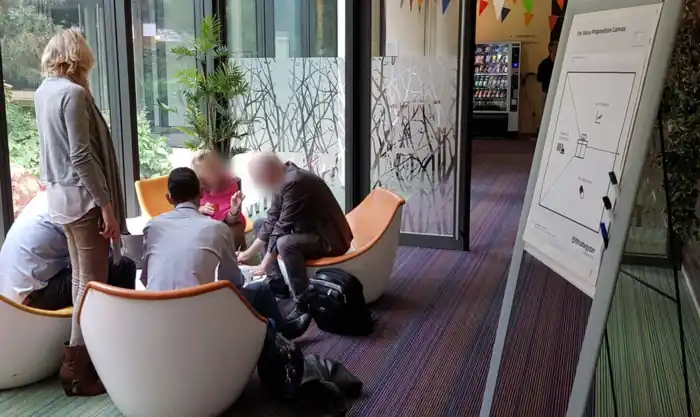
Our approach
Tailoring is not about changing the examples in existing slides. It means understanding the real work before designing anything.
1. Framing
A conversation with the sponsor to set out what is at stake behind the request, the constraints, and what will need to have changed by the end. It is also where we check that training is the right answer — sometimes it isn’t.
2. Preparation
Short interviews or a questionnaire with participants, to gather their situations and their actual level. The design is built from that material, not ahead of it.
3. Delivery
Alternating experiments, collective review and short input. The pace is adjusted in the room: an exercise that takes hold often produces more than a module finished on time.
4. Embedding
Individual commitments, practices attached to the team’s rituals, and where relevant a follow-up session a few weeks later to look at what held and what resisted.
The formats. From half a day to a programme spread over several months, on site at your premises or elsewhere, remotely, or combining both. The work happens in a small group: everyone needs to practise several times, which a large cohort rules out. Sessions are run in French or in English.
References
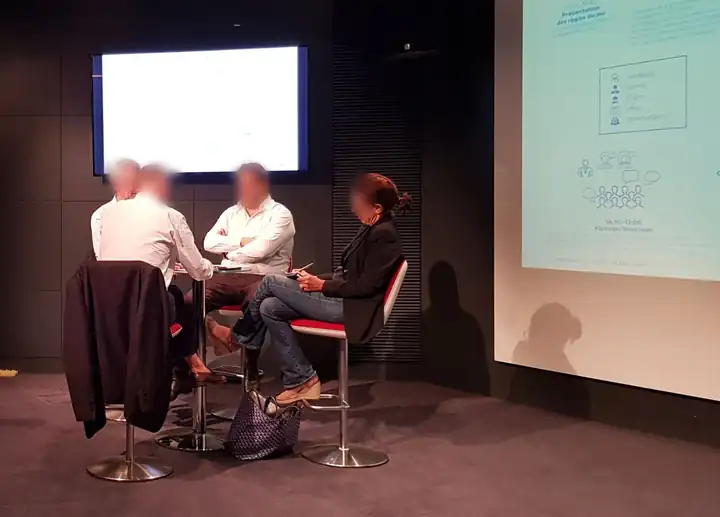
A few engagements
Partners of a major audit and consulting firm
Leadership modules designed for Deloitte partners, within their development programmes. An audience of seasoned experts, for whom extra theory has no value: what counts is a shift in stance they can observe themselves.
The HR teams of a luxury house
Work with Chanel’s human resources on cooperation and the quality of professional exchanges — a context where expectations about form run high, and where saying things plainly is precisely what needs working on.
A banking group
Support and training for managers in a heavily regulated environment, where the rules leave little room and cooperation therefore plays out mainly in how people talk to each other.
International contexts, in English
Work with IBM, Publicis Sapient and Murex (Dublin), with multicultural and distributed teams. Running a session in English is not a matter of translating content: voicing a disagreement doesn’t work the same way from one culture to another.
And also
Orange, Givaudan, Believe, Hôpital Sainte-Anne. Very different sectors, sizes and cultures — what looks alike from one assignment to the next is not the content, it is the way it is built.
What your teams gain
- Reflexes already tried in front of their peers, not concepts they have heard
- A shared language that outlives the session and gets used in meetings
- Commitments attached to existing rituals, not added alongside them
- The ability to handle the next difficult situation without us
And, where the design allows for it, a follow-up session a few weeks later to look at what held — and above all at what resisted.
Passing it on
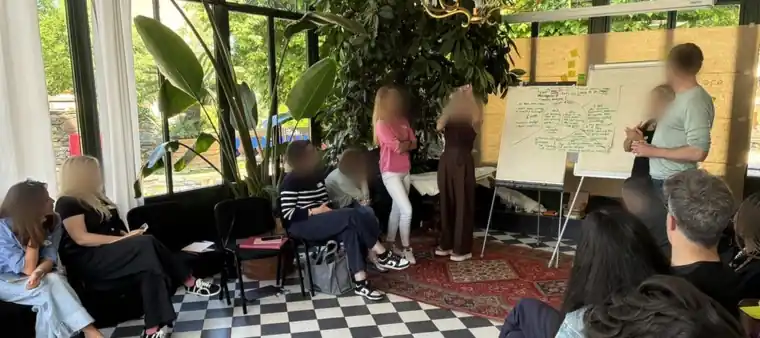
Teaching, too
Since 2024 I have taught group psychodynamics in the Master 2 in Human Resources Management at CIFFOP (Université Paris-Panthéon-Assas). Training future HR professionals in what plays out within a group demands a clarity that companies don’t always ask for — and that demand carries over into the training I design.
I also lead the training activity of the Institut de la Sociodynamique, which works on power relations, alliances and stakeholder strategies within organisations. A useful lens as soon as a transformation runs into something other than a skills problem.
And what about Clear Leadership?
RE-LIER is one of the few certified providers in France for Clear Leadership®, an approach that gives a team a simple language for saying what is really going on, without judgement. It is a programme in its own right, with its own content and its own calendar.
It has its own page on this site: the Clear Leadership training, and its own website: Leadership par la Clarté (Clear Leadership®). The principles it teaches run through the other programmes, but they are not their content.
Frequently asked questions
In what way is your training really “tailor-made”?
The design is written after gathering participants’ situations, not before. Two sessions on the same theme, for two different companies, share neither the same exercises nor the same flow. What repeats from one to the next is the design method, not the content.
How long does a programme last?
From half a day on a specific subject to a programme running several months for a population of managers. A single day rarely changes a practice: two or three sessions spaced out, with application in between, produce markedly more.
Do you work remotely?
Yes, and remote is not a degraded version: it simply calls for different sequences, shorter, with more breakout groups and shared visual materials. Some programmes run entirely remotely, others combine a day on site with shorter video sessions.
How many participants?
A small group, so that everyone can practise several times and be observed. Beyond that you fall back into a lecture: everyone understands, nobody practises. For a larger population, we run several successive groups.
Do you work in English?
Yes, and in genuinely international settings — IBM, Publicis Sapient, Murex in Dublin. Beyond the language, it means taking account of how disagreement, feedback or silence are experienced differently by the cultures in the room.
What is left once the training is over?
Commitments made by participants in front of their peers, attached to their existing rituals rather than added alongside. Depending on the setup, a follow-up session a few weeks later makes it possible to look at what held — and above all at what resisted, which is often more instructive.
How does this differ from team coaching?
Training develops skills in individuals brought together for the occasion. team coaching works on how an established collective functions, on its real subjects. The two often combine: training sets the shared language, coaching embeds it in daily work.
Let’s talk about your training needs
A first 30-minute conversation, with no commitment, to understand the situation behind the request and see what training can — or cannot — change. If another answer fits better, I will say so.
See also: Leadership team coaching · coaching for executives · offsite facilitation
 English
  French