
Leadership team coaching: helping your executive committee decide and move forward together
An executive committee brings together capable people. And yet it does not always work as a team: decisions drag on, trade-offs get pushed up to the chief executive, sensitive subjects are avoided, meetings inform rather than settle anything. Leadership team coaching works precisely on what happens between its members, so that the leadership team becomes a genuine collective that steers the business.
This work is not about your strategy — you know it better than anyone. It is about the way your team discusses it, decides it and carries it. That is often where the energy of an otherwise solid leadership team gets lost.
When we are called in
A chief executive rarely calls to “do some team coaching”. They call because one specific situation will not shift. Here are the five we meet most often.
A new appointment. A new leader arrives and has to bring together a team they did not choose. The first few months decide a great deal: everyone is watching, testing how much room they have, waiting to see whether the stated rules will hold. Setting out explicitly how the team is expected to work is better than letting it settle by default.
A reorganisation, a merger or a demerger. Remits shift, roles overlap, and trade-offs that used to be obvious become live issues again. The team has to rebuild its own way of working at the very moment it is leading the change for everyone else.
Tension between functions. Sales, operations, finance, HR: each defends a legitimate remit, and cross-functional projects grind to a halt. These are rarely problems with people. They are almost always disagreements that have never been put on the table.
Meetings that settle nothing. The leadership meeting is long, informative, consensual in appearance — and the real conversations happen in the corridor straight afterwards. Decisions go up to the chief executive, who settles alone what the team should have settled together.
A transformation to lead. The leadership team has to set the example before asking managers to change. If it does not work the way it preaches, the message does not land — and managers see that very quickly.
What is blocking things is not always what you think
Quand un comité de direction fonctionne mal, l’explication spontanée tient en quelques mots : untel est trop politique, l’autre ne joue pas collectif, le dirigeant ne tranche pas assez. Ces lectures sont rarement fausses, mais elles sont rarement utiles : elles désignent des personnes là où le problème est relationnel et systémique.
In most of the committees we work with, three mechanisms come up again and again.
The unsaid
Each person keeps to themselves what they observe, think or feel — to save time, or to avoid a conflict. The information a decision most lacks is precisely what nobody says.
Interpretations
“He said that to protect his budget.” Perhaps. But until the assumption is checked, the team is working on a fiction it ends up sharing.
Avoidance
Without enough psychological safety, the more important a subject is, the more it costs to raise it. It then comes back in other forms: slowness, disengagement, decisions reopened three times.
This is exactly the ground covered by Clear Leadership®, of which RE-LIER is one of the few certified providers in France. It gives a leadership team a simple language and the key skills to say what is really happening, without judgement, and to hold the conversations that allow people to learn and build together. That is often the turning point.
What teams say to each other when the setting allows it
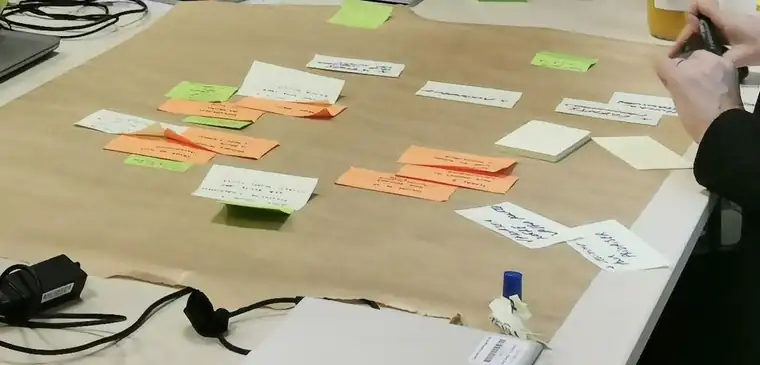
At the end of a workshop, each member of the committee says what they observed, what they take from it, and what they intend to do about it. The lines below were taken down word for word during an alignment workshop between a parent company and its subsidiaries. Nothing was suggested or reworded.
What the team sees
“A lot of ‘yes, but’: debates that start over and over on points that could be fairly simple.”
“There is a great deal left implicit in how we put things and in what the words mean.”
“When someone states a need, it is not always very clear.”
“Apprehension. We watch each other, we size each other up.”
“A strong demand for precision on both sides.”
What it does with it
“We have reproduced the flaws of the organisation we came from. We have every interest in working together to avoid rebuilding the silos.”
“The vocabulary boxes us in and projects us into something we do not necessarily want.”
“I expect nothing from anyone, I am going to give to everyone: what I do not do, nobody will do in my place.”
“Once we have a shared objective, we will enjoy doing it together.”
“The will is there; the answer will be in the execution.”
That shift is the heart of the work. In the left-hand column, a team describes clearly what is stopping it moving forward — and does so without blaming anyone. In the right-hand column, it draws conclusions no consultant could have imposed on it. Between the two there is no miracle method: only a setting in which you can name what you observe without it becoming an accusation.
This collective realisation becomes the engine and the fuel of an action plan each member commits to in front of their peers.
Our approach
Every engagement is designed for the situation, but it generally follows five stages.
1. Framing
A conversation with the leader: what they observe, what they have already tried, what they expect and what they fear. We also check here that team coaching is the right answer — sometimes it is not, and that is better said before we start.
2. Diagnosis
A one-hour individual interview with each member, and observation of one or two leadership meetings. The aim is not to collect complaints but to understand the real dynamics: who speaks, who stays silent, how decisions get made. Allow three to four weeks.
3. Feedback
A half-day with the whole team, in which it hears an anonymised summary of what was said and everyone can respond. It is the most demanding moment of the engagement, and often the most decisive. It ends with two or three shared objectives.
4. Team sessions
Half-day sessions, roughly one a month, on your real subjects rather than textbook cases: roles, decision rules, the quality of exchanges, handling disagreement. The work is done on live files, not alongside them.
5. Follow-up
Concrete practices built into your leadership rituals — agendas, round-table turns, the way a decision is closed. Then a review against the objectives set at the feedback session, shared with the chief executive.
The work takes place in Paris and the Île-de-France region, elsewhere in France or abroad, at your premises or in an outside venue depending on what needs to be done, and can continue remotely between sessions. Engagements are delivered in French or in English.
Depending on the need, coaching the leadership team can be combined with individual coaching for some members, a launch team workshop and a training course in Leadership par la Clarté (Clear Leadership®) to establish a shared language, and longer-term support to embed the transformation and spread it through the organisation.
What your leadership team gains
Faster decisions, owned collectively. When disagreements are voiced in the room, the trade-off is made once. Decisions stop being reopened in the corridor and then taken again at the next meeting.
Disagreements addressed rather than avoided. The team learns to name what is stuck without it becoming personal. That is the most useful and the rarest skill in a leadership team.
Clearer allocation of roles. What the chief executive settles alone, what the team settles together, what is decided elsewhere. A great deal of slowness simply comes from the absence of that clarity.
A team able to carry others with it. A leadership team that is aligned and credible in the way it works itself gets from its managers what a divided one cannot, whatever the quality of the plan.
Concrete action, in the service of the strategy. The leadership team acts collectively and in shared responsibility to align the whole organisation on executing the strategy.
Concrete engagements
A new appointment that becomes a transformation
The context. A newly appointed chief executive wants to change the way their leadership team works: fewer silos, priorities that are genuinely shared, a team able to deliver and to carry the change to the whole organisation.
What we did.
- a course in agile ways of working, adapted to the leadership team and focused on its own ways of working and deciding;
- work on collaboration between members around shared priorities;
- a redesign of the organisation, led with the HR director;
- an offsite to launch the transformation with the teams;
- support for the transformation through training the teams;
What changed. At the workshop, the leadership team took an initiative nobody had asked of it: its members acted out, in short sketches, the way they worked “before” and “after” the engagement. A way of showing the teams openly how far they had come, and of setting the example of the change expected of them. That is the sign we look for: the moment the team no longer needs the coach in order to act.
Creating an Orange subsidiary
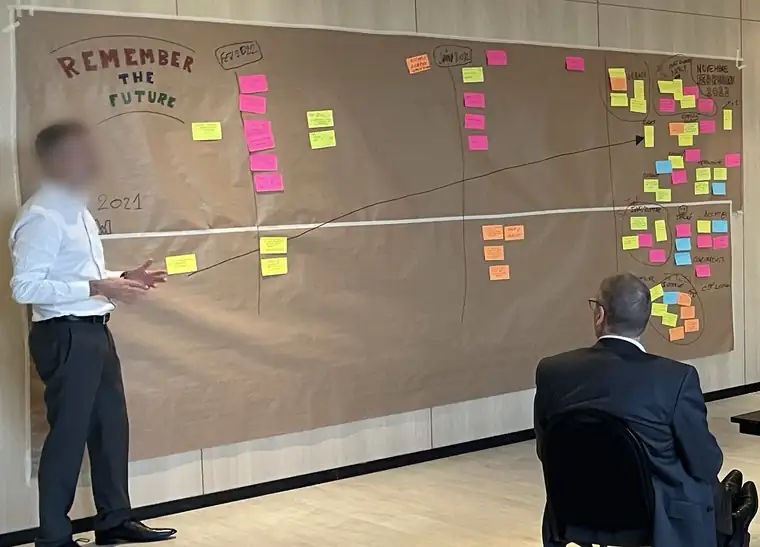
The context. In 2021, Orange created a subsidiary bringing together the twenty-four publicly funded networks it operates in rural areas. The project involved some fifty people across ten workstreams — information systems, HR, logistics, governance, data — with a non-negotiable launch date.
My role. I worked as a coach on this project, as a subcontractor for Sofrecom, the consulting firm supporting Orange through this carve-out. My work covered the leadership team, the project steering and the workstream teams.
The assessment. A year from the deadline, the leadership committee made a clear-eyed assessment: the workstreams were progressing in silos, with little coordination and no overall view. Interdependencies were multiplying, the project came on top of day-to-day work, and the teams due to join the future subsidiary were anxious for lack of information. The committee decided to change method and to bring in support — a courageous decision, which acted as a catalyst.
Three levers were used.
The leadership committee takes back its role
Absorbed by the “how”, it had not taken the time to put either the “what” or the “why” into words. It clarified the value proposition of the future subsidiary and set out a vision everyone could understand and make their own.
Governance is tightened
A small, very hands-on team took charge of coordination between workstreams, of removing obstacles as they arose, and of continuous communication to give meaning to what was being done.
The teams work differently
Short cycles, brief and regular points of synchronisation, reviews shared openly — and above all a retrospective moment in which the team examines its own way of working. That last point is what changes the most.
The outcome. The first effects appeared within a month, in the progress of the workstreams as much as in the energy the teams brought to working together and their commitment to building something. The method was then extended to the whole project. Orange Concessions launched on time, in November 2021.
What to know before you start. There is a difficult passage, and it is better to say so in advance. Far from the engineering culture that analyses and designs before building, this way of working requires accepting that you cannot know or control everything beforehand. The teams — and the leadership committee first of all — go through a period of doubt. That uncomfortable stretch is not a failure of the approach: it is part of it, and it is precisely there that support earns its keep.
At bottom, this work does not rest on any particular method: it brings the fundamentals of collaboration back to life. It gives the leadership committee back its role of vision and decision, instead of letting it get bogged down in day-to-day delivery. And it turns teams that were on the receiving end of the transformation into teams that build it.
Sofrecom has published a detailed account of this project and of the use of collaborative methods: Creating Orange Concessions.
Other examples: supporting the leadership team of a telecoms business unit through its demerger; alignment workshops between the parent company and the subsidiaries of an international TowerCo. See all our references.
Why RE-LIER
A coach who has been a company director. Seventeen years in business in senior management roles, in France and internationally, before becoming a coach in 2014. I know from the inside what a leadership team under pressure goes through — and what an outside consultant does not always see.
Proven practice with collectives. ICF-certified professional coach, trained in Gestalt and in the systemic approach, with more than 1,200 hours of team coaching. Working with a leadership team is not individual coaching applied to several people at once: it is a different craft.
A method that is rare in France. Certified trainer in Clear Leadership® and co-translator of the reference book published in 2022. It is the most effective approach I know for getting a leadership team out of the unsaid and the misunderstood.
In Paris and the Île-de-France region. On site at your premises or in a neutral venue, and remotely between sessions. In French or in English, which matters in committees with an international dimension.
Frequently asked questions
How long does leadership team coaching last?
Generally four to nine months, with roughly one collective session a month, preceded by a diagnosis. The length depends on what is at stake and on the team’s own rhythm.
Does the leader take part in the sessions?
Yes, most of the time: the coaching is about the leadership team as a whole, the leader included. Their role and expectations are clarified from the outset, because their stance during the sessions largely determines what the others allow themselves to say.
How is it different from a team-building offsite?
A team-building offsite creates a high point. Leadership team coaching works over time on how the team actually functions, so that the changes hold after the event. The two combine well: the offsite launches, the coaching embeds.
Are the conversations confidential?
Yes. The confidentiality framework is agreed with the team and the sponsor at the start, in line with the ICF code of ethics. What is said in session is not reported outside; only the objectives and the final review are shared with the sponsor.
What if a member of the committee is reluctant?
It is common, and it is not an obstacle. Reluctance is useful information, often shared silently by others. It is handled during the diagnosis, in the individual interview, and then in session if the person wishes. We never force anyone to speak.
How is the result measured?
Against the objectives set at the feedback session, which are deliberately observable: the time between a subject being raised and a decision being made, the number of decisions reopened, the felt quality of meetings. A review revisits them at the end of the engagement.
What does an engagement cost?
It depends on the number of members, the number of sessions and whether a workshop is included. The diagnosis and the feedback session are the fixed part, the sessions the variable part. A quote is drawn up after the first conversation.
Do you work outside the Île-de-France region?
Yes, occasionally. In-depth work does, however, benefit from regular face-to-face contact: for a committee that is a long way away, we look together at whether a format concentrated into a few days makes more sense.
Let’s talk about your leadership team
A first 30-minute conversation, with no commitment, to understand your context and see whether team coaching is the right fit. If it is not, I will tell you.
 English
  French